Manufacturing Model Selector
Define Your Product & Business
Recommended Model
- Watch out for:
Enter your business details to find the optimal production strategy.
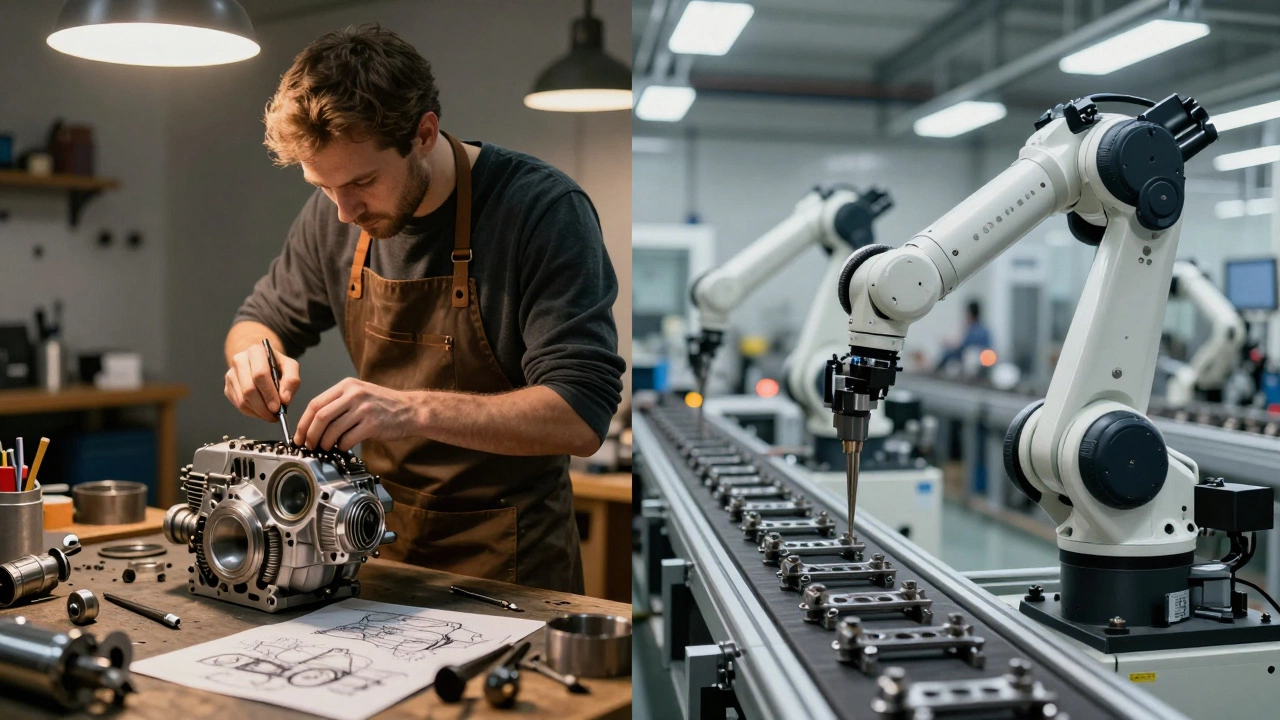
Picture a factory floor. In one corner, a single craftsman is hand-assembling a custom motorcycle engine. Across the room, a robotic arm is stamping out ten thousand identical car door hinges per hour. Both are manufacturing, but they operate on completely different logic, cost structures, and market needs. Understanding these differences isn't just academic-it’s the difference between choosing a profitable niche and burning through your startup capital.
If you are exploring manufacturing business ideas, knowing which production model fits your product is step one. You can’t sell high-margin bespoke furniture using a low-margin assembly line strategy. Conversely, trying to make soda bottles by hand will bankrupt you before you ship your first pallet. Here is the breakdown of the five primary types of manufacturing, how they work, and which ones actually make sense for new businesses in 2026.
1. Job Shop Production (Customization)
This is the oldest form of manufacturing. Think of it as the industrial version of a tailor or a chef creating a special dish. Every order is unique. The machinery moves around the product, not the other way around. A machine might drill holes today, paint tomorrow, and assemble next week, depending on what the customer asked for.
How it works: General-purpose machines (like lathes, mills, or sewing machines) are arranged by function, not by product flow. Workers need high skill levels because they have to set up machines for different tasks constantly. There is no "standard" product.
Best for: High-value, low-volume items. This includes aerospace components, custom jewelry, specialized medical devices, or prototype development. If you are starting a business making limited-edition artisanal goods or B2B custom parts, this is your lane.
- Pros: Extremely high flexibility; ability to charge premium prices for customization; lower initial investment in specialized tooling.
- Cons: Higher labor costs; slower production speeds; complex scheduling; difficult to scale without losing quality control.
2. Batch Manufacturing (Grouped Production)
Batch production is the sweet spot for many mid-sized manufacturers. Instead of making one thing at a time or millions of the same thing, you make fifty, then switch to another fifty of something else. Think of a bakery making a batch of sourdough loaves, cleaning the ovens, and then making a batch of croissants. Or a pharmaceutical company producing 10,000 units of Antibiotic A, then sanitizing the lines to produce 10,000 units of Painkiller B.
How it works: Products move in groups through the production process. Each stage must be completed for the entire batch before moving to the next. This requires changeover time-downtime spent reconfiguring machines for the new batch.
Best for: Food processing, cosmetics, clothing lines, and printed materials. It allows you to test market demand without committing to infinite inventory. If your business idea involves seasonal products or multiple SKUs (Stock Keeping Units), batch manufacturing reduces risk.
- Pros: Flexibility to produce multiple product variants; easier quality control per batch; lower inventory risk than mass production.
- Cons: Changeover times reduce efficiency; higher per-unit cost than mass production; potential for bottlenecks if one batch gets stuck.
3. Mass Production (Volume Scale)
You know this model. Henry Ford popularized it with the Model T, but today it applies to smartphones, laptops, and basic consumer electronics. The goal is simple: make as many identical items as possible, as cheaply as possible. The product design is fixed, and the process is rigid.
How it works: Dedicated equipment and assembly lines move products from station to station. Workers or robots perform repetitive, specialized tasks. The line runs continuously until maintenance or a shift change. Setup costs are high, but once running, the marginal cost of each additional unit drops significantly.
Best for: Consumer electronics, automotive parts, household appliances, and fast-moving consumer goods (FMCG). For entrepreneurs, this is rarely a starting point unless you have massive venture capital backing. However, understanding mass production is crucial if you plan to contract out your manufacturing to larger factories.
- Pros: Lowest cost per unit; high output volume; consistent quality; predictable supply chain.
- Cons: Extremely high upfront capital investment; inflexible (changing the product requires rebuilding the line); vulnerable to demand shocks (if people stop buying, you’re stuck with inventory).

4. Continuous Manufacturing (Non-Stop Flow)
This is heavy industry. Oil refineries, chemical plants, steel mills, and paper factories use continuous manufacturing. The material flows continuously through pipes, conveyors, or reactors. It doesn’t start and stop; it runs for months or years at a time. Stopping a continuous process is incredibly expensive and technically difficult.
How it works: Highly automated systems monitor temperature, pressure, and flow rates in real-time. Human intervention is minimal and mostly focused on maintenance and safety. The product is uniform by nature of the process.
Best for: Energy, chemicals, food ingredients (like sugar or flour), and metals. For most small-to-medium business owners, this category is off-limits due to regulatory hurdles, environmental compliance costs, and infrastructure requirements. However, if you are looking into food processing startups involving bulk liquids or powders, you may interface with suppliers who use this model.
- Pros: Maximum efficiency; lowest operational cost per unit over time; constant supply availability.
- Cons: Prohibitively high entry barriers; zero flexibility; catastrophic financial loss if the line stops; strict regulatory oversight.
5. Lean Manufacturing (Process Optimization)
Lean originated from Toyota’s production system. It’s not about *what* you make, but *how* you make it. Lean focuses on eliminating the "seven wastes": overproduction, waiting, transportation, over-processing, inventory, motion, and defects. Many modern businesses blend Lean principles with Job Shop or Batch methods to stay competitive.
How it works: Production is pulled by customer demand, not pushed by forecasts. Just-in-Time (JIT) inventory means you only buy materials when you need them. Workflows are mapped meticulously to remove any non-value-added steps.
Best for: Any manufacturing business aiming for profitability and agility. Startups in electronics manufacturing or furniture manufacturing often adopt Lean early to avoid cash flow traps caused by excess inventory. It’s a mindset that complements the other four types.
- Pros: Reduced waste; improved cash flow; higher quality; faster response to market changes.
- Cons: Requires cultural shift among staff; fragile supply chains (no buffer stock); steep learning curve for implementation.
Comparison of Manufacturing Types
| Type | Volume | Variety | Cost Per Unit | Flexibility | Best For |
|---|---|---|---|---|---|
| Job Shop | Low | High | High | Very High | Custom parts, prototypes |
| Batch | Medium | Medium | Medium | Medium | Food, pharma, apparel |
| Mass | High | Low | Low | Low | Electronics, autos |
| Continuous | Very High | None | Lowest | None | Chemicals, oil, steel |
| Lean | Variable | Variable | Optimized | High | Any model seeking efficiency |
Choosing the Right Model for Your Startup
Selecting a manufacturing type isn't just about engineering; it's a financial decision. Ask yourself three questions:
- What does the customer value more: uniqueness or price? If they want a custom fit, go Job Shop. If they want the cheapest option, aim for Mass or Batch.
- What is your capital runway? Continuous and Mass production require millions in setup. Job Shop and Batch can often start in a garage or small warehouse.
- How volatile is demand? If trends change monthly (like fashion), Batch or Lean is safer. If demand is stable (like basic screws), Mass Production wins.
For most new entrepreneurs in 2026, the trend is toward hybrid models. Use 3D printing (a form of digital job shop) for prototyping, then switch to small-batch injection molding for initial sales. As volume grows, automate gradually. Don’t lock yourself into a rigid system before you’ve validated the market.
Which manufacturing type is best for a beginner?
Job Shop or small-scale Batch manufacturing is usually best for beginners. These models require lower upfront capital, allow for product iteration based on customer feedback, and don't require complex automation. They let you learn the ropes of supply chain and quality control without risking millions in equipment.
Can I switch from Batch to Mass Production later?
Yes, but it requires significant re-engineering. Moving from Batch to Mass Production means redesigning your product for standardization, investing in dedicated tooling, and potentially relocating to a larger facility. Plan for this transition early by designing modular components that can be easily assembled on a line.
Is Lean Manufacturing a separate type?
Technically, Lean is a methodology, not a physical production layout. However, because it fundamentally changes how resources are allocated and how waste is viewed, it operates as a distinct operational philosophy. Most successful modern manufacturers integrate Lean principles into their Job Shop, Batch, or Mass Production systems.
What is the main disadvantage of Continuous Manufacturing?
The main disadvantage is inflexibility and high barrier to entry. Once a continuous line is running, you cannot easily change the product. Additionally, the initial investment in infrastructure (pipes, reactors, sensors) is enormous, making it unsuitable for all but the largest industrial players.
How does technology impact traditional manufacturing types?
Technology blurs the lines. Additive manufacturing (3D printing) allows for "mass customization," combining the volume of mass production with the uniqueness of job shops. IoT sensors enable predictive maintenance in continuous processes, reducing downtime. Automation is making batch changeovers faster, reducing the cost gap between batch and mass production.