Furniture Import Cost Estimator
Enter your shipment details below to estimate the total landed cost. This tool helps you avoid budget surprises by accounting for packaging, freight, insurance, duties, and local handling.
Please enter values and click Calculate.
You see a stunning teak wood dining table on an Indian manufacturer’s website. The price tag looks incredible-maybe $400 for a piece that would cost $1,500 at your local boutique. You hit "buy," expecting a simple transaction. Then the invoice arrives, and suddenly that $400 table costs $900 because of freight, insurance, port fees, and taxes. If you don’t know how to calculate the furniture import cost before you commit, you’re gambling with your budget.
Importing from India isn’t just about finding cheap labor; it’s about understanding the logistics chain. Whether you are a homeowner furnishing a new build or a retailer stocking up, the landed cost is what matters. This guide breaks down every dollar involved in bringing furniture from India to your door, using real-world numbers as of late 2026.
The Product Cost: What Are You Actually Buying?
Before we talk about ships and customs, let’s look at the factory gate price. India is a global hub for solid wood, rattan, and metal furniture. Cities like Jodhpur (wood), Moradabad (metal), and Saharanpur (carved wood) dominate production. Prices vary wildly based on material quality and craftsmanship.
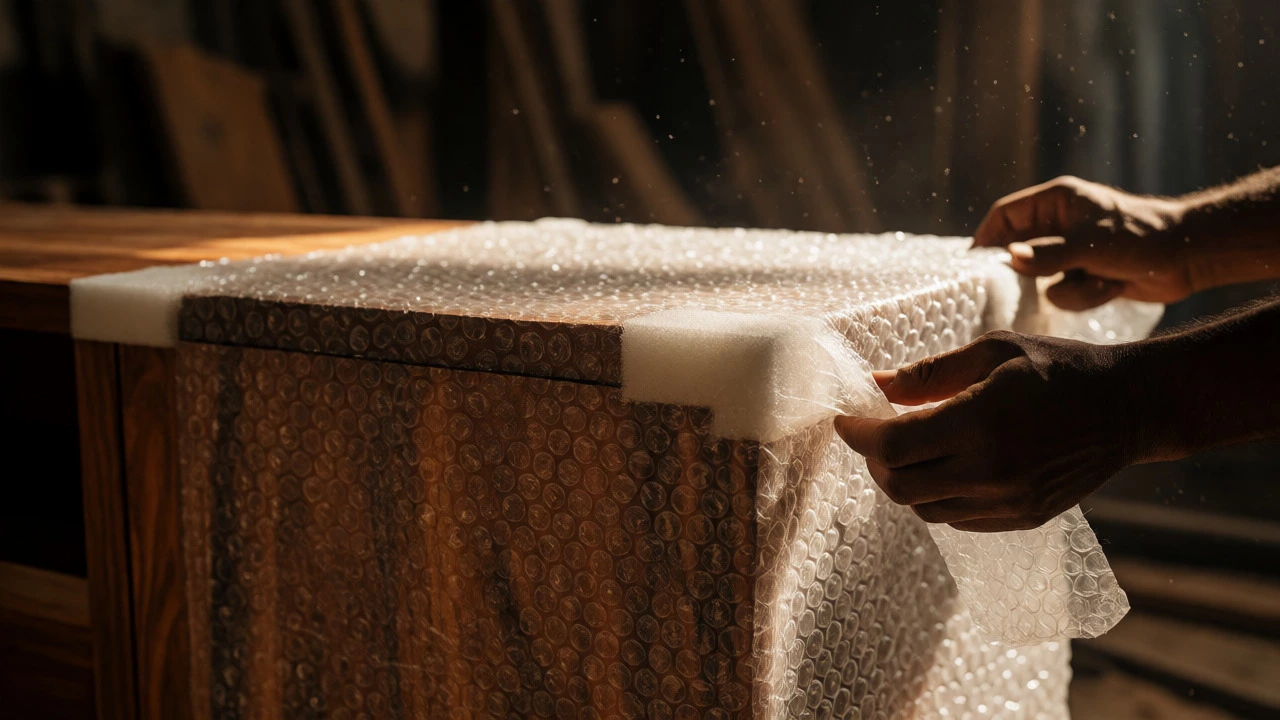
A standard solid sheesham (Indian Rosewood) sideboard might cost between $150 and $300 USD directly from the manufacturer. In contrast, mass-produced particle board items might be under $50. But here is the trap: many quotes exclude packaging. Furniture is bulky and fragile. Proper export-grade packaging-bubble wrap, foam corners, and heavy-duty wooden crates-can add 10-15% to the base product cost. Always ask if the quote is EXW (Ex Works) or FOB (Free on Board). EXW means you pay for pickup from the factory; FOB means the seller covers transport to the port. For beginners, FOB is safer but slightly more expensive upfront.
| Item Type | Material | Low Range (USD) | High Range (USD) |
|---|---|---|---|
| Dining Table (6-seater) | Solid Teak/Sheesham | $250 | $450 |
| Armchair | Rattan/Wicker | $80 | $150 |
| Bed Frame (Queen) | Mango Wood | $120 | $220 |
| Bookshelf | Engineered Wood | $40 | $90 |
Ocean Freight: The Biggest Variable
This is where most people get burned. Shipping rates fluctuate daily based on fuel prices, geopolitical issues, and container availability. As of October 2026, ocean freight from major Indian ports like Nhava Sheva (Mumbai) or Mundra to North American or European hubs has stabilized somewhat compared to the pandemic chaos, but it’s still volatile.
You have two main options: LCL (Less than Container Load) or FCL (Full Container Load).
- LCL: You share a container with other shippers. You pay by cubic meter (CBM). Current rates hover around $80-$120 per CBM for basic freight, but beware of destination charges. These hidden fees often exceed the freight itself.
- FCL: You rent a whole 20ft or 40ft container. A 20ft container holds roughly 28-30 CBMs. Rates currently range from $1,800 to $3,500 depending on the destination port. If you are buying enough furniture to fill 15+ CBMs, FCL is usually cheaper per unit.
Let’s say you buy $2,000 worth of chairs. They occupy 5 CBMs. At $100/CBM, freight is $500. Add origin handling ($150) and destination terminal handling charges (THC) which can hit $300-$500. Suddenly, your shipping bill is nearly half the value of your goods.
Customs Duties and Taxes: The Government’s Cut
Once your cargo lands, customs officials want their share. This depends entirely on your country’s trade agreements with India. Since I’m writing from New Zealand, let’s use that as a baseline, but the logic applies globally.
In New Zealand, general furniture imports attract a 10% duty. However, under the NZ-India PTA (Preferential Trade Agreement), many furniture categories enter duty-free if you have the correct Certificate of Origin. Always demand this document from your supplier. Without it, you pay full tariff.
Then there’s GST (Goods and Services Tax). In NZ, it’s 15%; in the US, it varies by state sales tax; in Australia, it’s 10%. This tax is calculated on the *landed cost* (Product + Freight + Insurance + Duty). So if your total pre-tax cost is $1,000, and duty is $100, GST is calculated on $1,100, not just the $1,000.
Pro Tip: Check the HS Code (Harmonized System Code) for your specific item. Wooden furniture falls under Chapter 94. Misclassifying code can lead to fines or delays. Use tools like the WTO Tariff Finder to check exact rates for your destination.

Hidden Fees That Kill Your Budget
The invoice rarely shows the final number. Here are the sneaky costs:
- Bill of Lading Fee: $50-$100 per shipment.
- Customs Brokerage: Unless you do it yourself, hire a broker. Expect $150-$300 per entry.
- Storage/Demurrage: If your paperwork isn’t ready when the ship docks, you pay daily storage fees. This can spiral to $100/day quickly.
- Inspection Fees: Some countries require fumigation certificates for wooden furniture to prevent pest introduction. This costs $50-$100.
- Last Mile Delivery: Port-to-door delivery is separate. A truck from the port to your warehouse might cost $200-$500 depending on distance.
Calculating Your Total Landed Cost
Stop guessing. Use this formula to find your true cost:
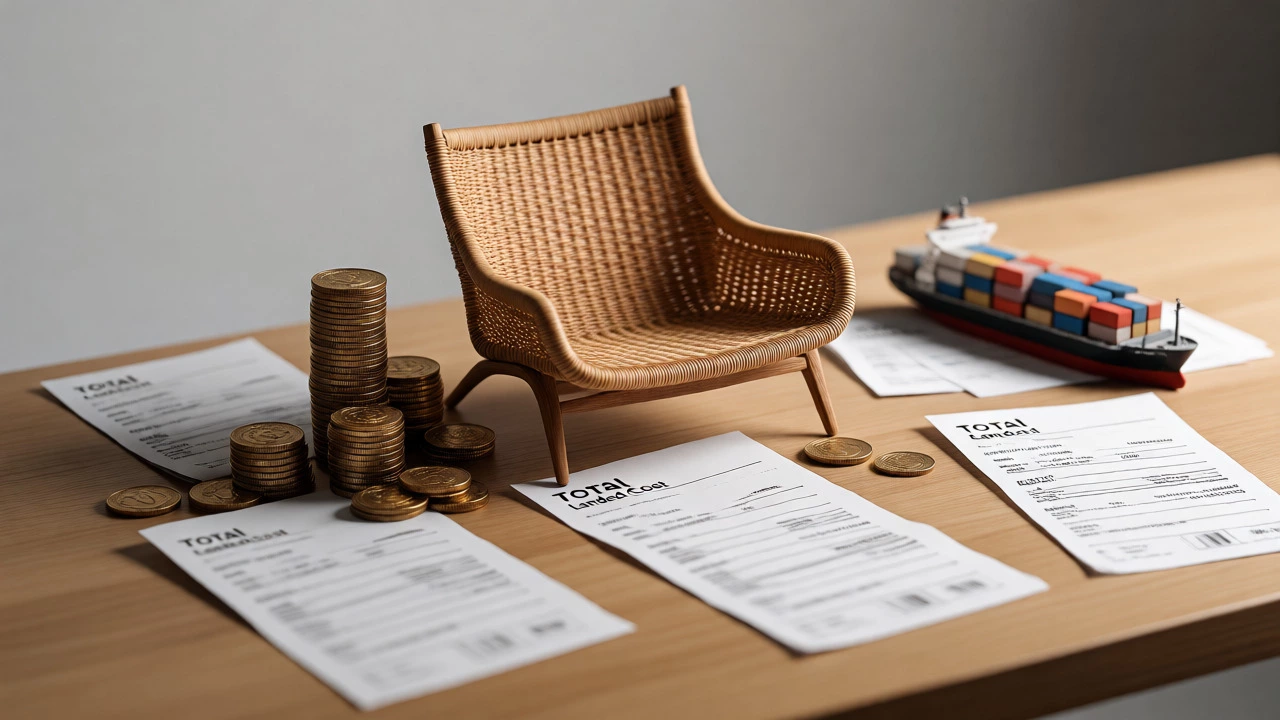
Total Landed Cost = Product Cost + Packaging + Ocean Freight + Insurance + Customs Duty + GST/VAT + Local Transport + Brokerage
Let’s run a realistic scenario. You import 10 rattan armchairs.
- Product Cost (FOB): $1,000 ($100/chair)
- Packaging: $150
- Ocean Freight (LCL): $400
- Insurance (0.5% of value): $7
- Customs Duty (0% due to PTA): $0
- GST (15% on CIF): $232
- Brokerage & Port Fees: $350
- Local Trucking: $150
Total: $2,289. Per chair cost: $228.90. If you sold these for $450, your margin is healthy. If you thought they cost $100, you’d be losing money.
Quality Control: The Risk Factor
Cheaper doesn’t mean better if it arrives broken. Indian manufacturing is skilled, but variability exists. Always order samples first. Never trust photos alone. Ask for video calls during packing. If you skip inspection, you risk receiving water-damaged wood or loose joinery.
Hiring a third-party inspection agency in India costs $200-$300 per visit. It’s worth every cent for orders over $2,000. They check moisture content in wood (should be below 12%) and structural integrity. Remember, returning furniture to India is financially impossible. Fix it locally or scrap it.
When Does Importing Make Sense?
Is it always cheaper? No. Small orders lose out to high fixed logistics costs. If you’re buying one sofa, buy locally. The hassle and cost won’t justify the savings. Importing becomes profitable when you move volume. Think in terms of containers, not individual pieces.
Also, consider lead times. Production takes 4-6 weeks. Shipping takes 4-8 weeks. Clearing customs takes 3-10 days. You need patience. If you need furniture next month, air freight is an option, but it costs 5-10x more than sea freight.
Final Checklist Before You Wire Money
- Verify the supplier’s business registration (GST number in India).
- Negotiate Incoterms clearly (FOB is recommended).
- Get a written proforma invoice detailing all costs.
- Secure a Certificate of Origin for duty benefits.
- Arrange marine insurance covering "All Risks".
- Confirm local customs requirements for timber treatment.
Importing furniture from India offers access to unique designs and competitive pricing, but only if you respect the logistics complexity. Do the math before you buy, and you’ll avoid the shock of the final invoice.
How long does it take to import furniture from India?
Typically 8 to 12 weeks total. This includes 4-6 weeks for production, 4-8 weeks for ocean transit, and 3-10 days for customs clearance. Air freight reduces transit time to 5-10 days but significantly increases cost.
Do I need to pay customs duty on furniture from India?
It depends on your country. Many nations offer reduced or zero duties under trade agreements like the GSP (Generalized System of Preferences) or bilateral PTAs. You must provide a valid Certificate of Origin to claim these benefits. Otherwise, standard tariffs apply, often ranging from 5% to 10%.
What is the cheapest way to ship furniture from India?
Ocean freight via LCL (Less than Container Load) is the cheapest for small to medium shipments. For large volumes, booking a full FCL (Full Container Load) container lowers the per-unit cost. Avoid air freight unless speed is critical, as it is exponentially more expensive.
Can I return damaged furniture from India?
Practically, no. International return shipping costs often exceed the item's value. Most buyers negotiate a partial refund or credit against future orders instead. Always inspect goods upon arrival and file claims with your insurer immediately if damage is found.
Which Indian cities are best for furniture sourcing?
Jodhpur and Saharanpur are hubs for solid wood and carved furniture. Moradabad specializes in brass and metal work. Mumbai and Delhi act as major trading centers with easier access to exporters and logistics providers.