Manufacturing Waste Calculator: Push vs. Pull
Calculate the hidden costs of overproduction (Push system) versus the savings from lean production (Pull system). Based on the principles of TIMWOOD and the Toyota Production System.
Total Monthly Hidden Costs
$0.00
- Storage Cost: $0.00
- Defect Rework/Scrap: $0.00
- Tied-Up Capital: $0.00
Total Monthly Hidden Costs
$0.00
- Storage Cost: $0.00
- Defect Rework/Scrap: $0.00
- Tied-Up Capital: $0.00
Monthly Savings with Lean Production
$0.00
By reducing inventory buffers and exposing defects early, you save significantly on storage and waste. This capital can be reinvested into R&D, marketing, or staff.
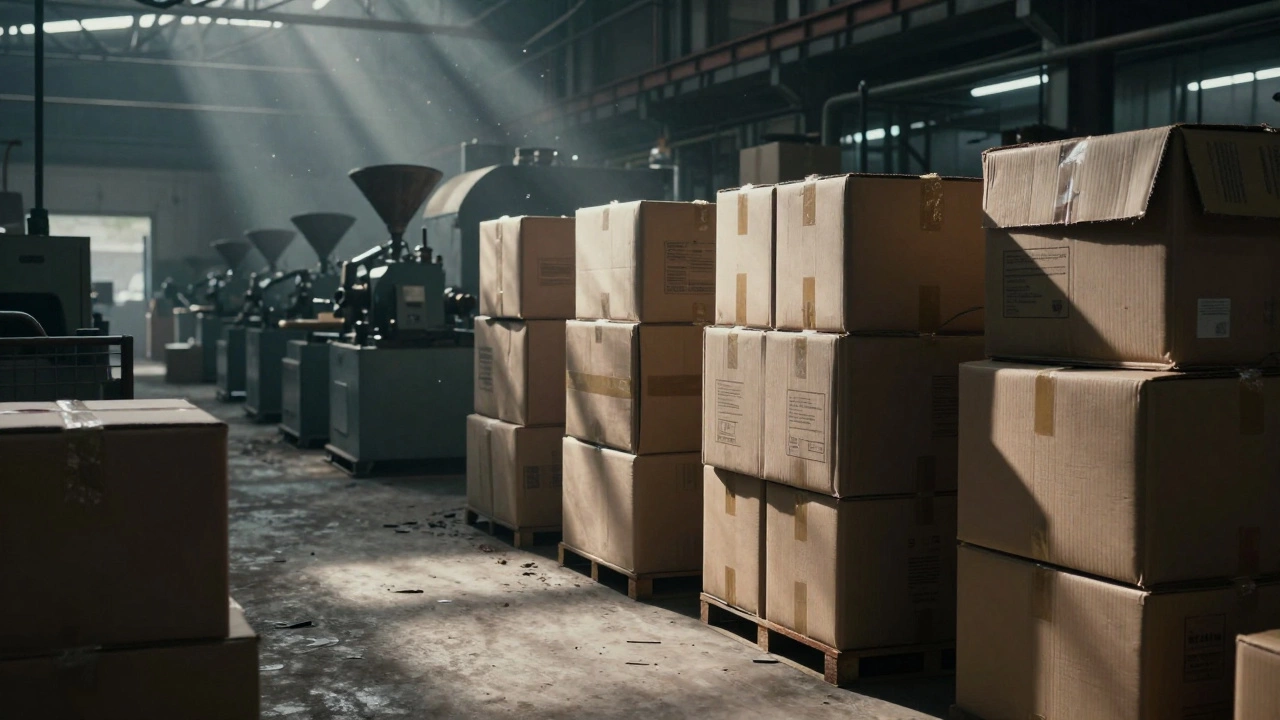
Imagine a factory floor humming with activity. Machines are running, workers are busy, and boxes are piling up. It looks like success. But look closer at that pile of boxes. They aren't shipping out today. They aren't even shipping next week. They are sitting there, gathering dust, tying up cash, and taking up valuable space. This isn't just clutter; it is the single biggest leak in the bucket of manufacturing profitability.
If you are looking to start a manufacturing business or optimize an existing one, understanding waste is not just academic-it is survival. In the world of production, waste isn't just trash in a bin. It is any step, material, or hour that does not add value for the customer who pays the bill. And while scrap metal and defective parts get all the attention, they are rarely the worst offender.
The Silent Killer: Overproduction
In the hierarchy of manufacturing sins, overproduction is creating goods before they are needed or in quantities greater than demand. It is widely considered the most dangerous form of waste because it hides all the other problems. When you produce too much, too early, you create a domino effect of inefficiency that drains resources faster than any machine breakdown ever could.
Why is overproduction so bad? Because it forces you to pay for things before you have earned the revenue from them. You buy raw materials earlier than necessary. You use labor hours to make items that sit idle. You rent warehouse space to store products that haven't been sold yet. Worse, if market trends shift-even slightly-those piles of unsold goods become obsolete. A smartphone case made for a model released two years ago is now just plastic waste, regardless of how perfectly it was manufactured.
This concept comes directly from the Toyota Production System (TPS), which revolutionized global manufacturing by focusing on eliminating waste through continuous flow and pull-based production. TPS identifies seven types of waste, often remembered by the acronym TIMWOOD. Overproduction sits at the top because it amplifies the impact of the other six.
The Seven Types of Manufacturing Waste (TIMWOOD)
To truly grasp why overproduction reigns supreme, you need to see how it interacts with the other forms of waste. These categories help you diagnose where your operations are bleeding money.
- Transportation: Moving materials unnecessarily. Every time a part moves without being worked on, it risks damage, delay, or loss. Overproduction increases transportation because you have more stuff to move around the facility.
- Inventory: Excess raw materials, work-in-progress (WIP), or finished goods. Inventory ties up capital. If you have $100,000 worth of steel sitting in a corner, that is $100,000 you cannot use for marketing, R&D, or paying staff. Overproduction creates this excess inventory.
- Motion: Unnecessary movement by people. If a worker has to walk 50 meters to fetch a tool because it wasn't organized properly, that is wasted time. High inventory levels often force workers to navigate crowded aisles, increasing motion waste.
- Waiting: Idle time when people or machines wait for the next step. If Machine A produces faster than Machine B can process, Machine B waits. Overproduction often masks these bottlenecks by creating buffers of WIP, making the line look smooth while hiding the underlying imbalance.
- Over-processing: Doing more work than the customer requires. Polishing a part that will be painted over, or adding features no one asked for. This wastes energy and time. Overproduction encourages this because managers try to justify the extra output by "improving" the product unnecessarily.
- Defects: Products that fail quality checks. Defects require rework or scrapping. When you overproduce, defects hide deeper in the pile. You might not discover a flaw until weeks later, by which time you've produced hundreds of bad units.
- Underutilized Talent: Ignoring the ideas and skills of your workforce. This is the eighth waste added in modern lean thinking. If operators don't know why they are rushing to fill shelves rather than meeting actual orders, morale drops, and innovation stalls.
Why Startups Fall Into the Overproduction Trap
New manufacturing businesses often fall into the trap of overproduction due to psychological and structural pressures. There is a deep-seated belief that a full factory floor equals a healthy business. Investors want to see scale. Customers want immediate delivery. So, founders push to produce as much as possible, as fast as possible.
Consider a startup making custom furniture. The founder sees an order for ten tables. Instead of making ten, they decide to make fifty because wood prices are low and the team is motivated. Six months later, only thirty have sold. The remaining twenty are occupying storage space that costs $500 a month. The cash tied up in those tables prevented the company from hiring a salesperson who could have secured larger contracts. The initial "smart" decision to bulk-produce became a strategic anchor.
This behavior is exacerbated by traditional cost accounting methods that reward volume. Many factories measure success by "units produced per day" rather than "value delivered to customers." This metric incentivizes workers to keep machines running even when there is no downstream demand, creating mountains of WIP that clog the system.
The Cost of Hiding Problems
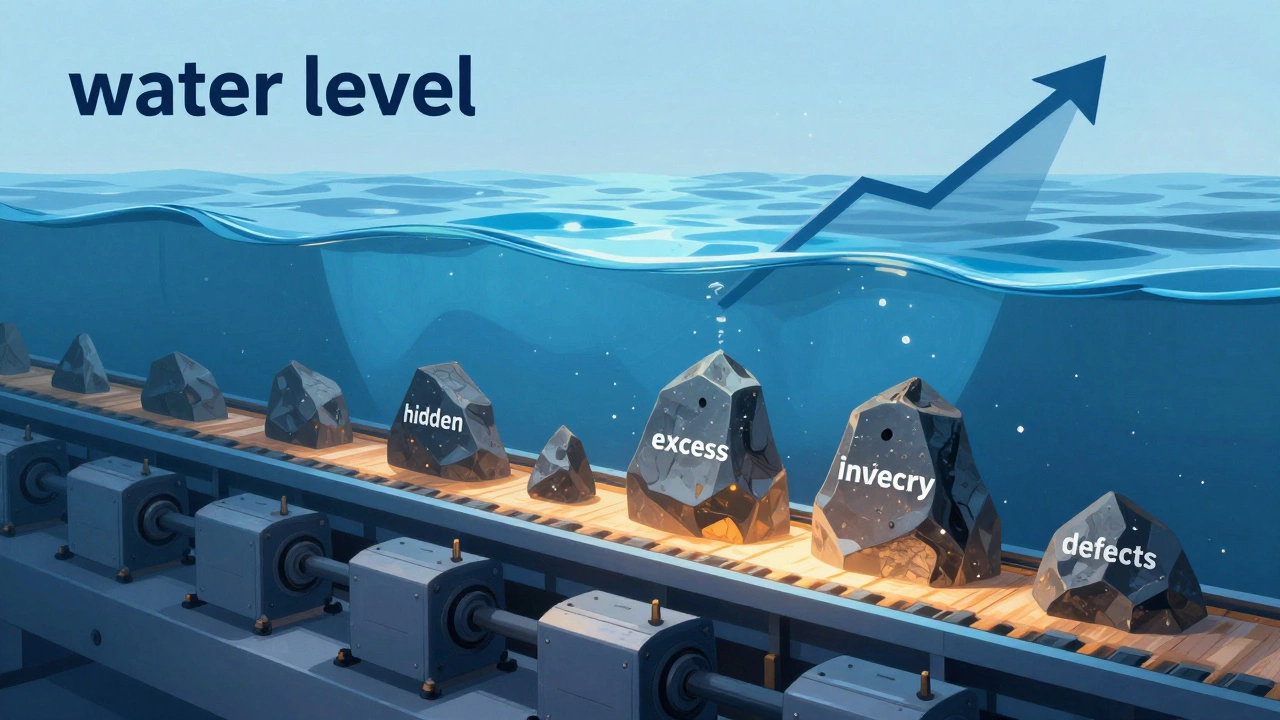
The most insidious aspect of overproduction is that it acts as a blanket, covering up inefficiencies elsewhere in the process. Think of water flowing under rocks in a river. If you raise the water level (by producing more inventory), the rocks (problems) disappear from view. The flow seems smooth. But the rocks are still there, waiting to cause turbulence when the water level drops.
For example, if your assembly line has a bottleneck at Station 3, but Station 1 is pumping out parts twice as fast, you build up a buffer of parts between Station 1 and Station 3. The line keeps moving. No one feels the pain of the bottleneck immediately. However, this buffer consumes space and capital. More importantly, it delays the realization that Station 3 needs fixing. By the time the buffer runs out and the whole line stops, the problem has festered for weeks or months.
Lean manufacturing advocates for lowering the water level. By producing only what is needed, you expose the rocks. Bottlenecks become visible. Quality issues surface immediately. Equipment failures halt production right away, forcing you to address root causes rather than treating symptoms. This approach feels uncomfortable at first-production slows down, visibility of chaos increases-but it leads to sustainable, long-term efficiency.
| Feature | Push System (Traditional) | Pull System (Lean) |
|---|---|---|
| Production Trigger | Forecasted demand | Actual customer order |
| Inventory Level | High (buffers everywhere) | Low (just-in-time) |
| Cash Flow Impact | Negative (capital tied up) | Positive (faster turnover) |
| Problem Visibility | Hidden by excess stock | Exposed immediately |
| Flexibility | Low (hard to change mix) | High (easy to adapt) |
| Risk of Obsolescence | High | Minimal |
How to Eliminate Overproduction: Practical Steps
Shifting from a push mindset to a pull mindset requires cultural and operational changes. Here is how you can start reducing the biggest waste in manufacturing today.
- Implement Kanban Signals: Use visual cards or digital signals to trigger production only when downstream processes consume items. If a box of components is empty, a signal is sent to replenish exactly that amount. No more, no less.
- Level Your Production (Heijunka): Instead of producing in large batches (e.g., 1,000 red widgets on Monday, 1,000 blue on Tuesday), mix the production schedule. Make 100 red and 100 blue each day. This reduces WIP and allows you to respond quickly to changes in customer preference.
- Reduce Setup Times (SMED):** Large batches often exist because changing over a machine takes hours. By applying Single-Minute Exchange of Die techniques, you can reduce setup times to minutes. This makes small-batch production economically viable, removing the incentive to overproduce.
- Align Metrics with Value: Stop rewarding employees for "machine utilization" or "units produced." Reward them for "on-time delivery," "first-pass yield," and "inventory turns." What gets measured gets managed.
- Engage Suppliers in Pull: Extend the pull system upstream. Work with suppliers to deliver smaller quantities more frequently. This reduces your raw material inventory and frees up cash.
The Role of Technology in Modern Waste Reduction
In 2026, technology offers powerful tools to combat overproduction, but it must be applied wisely. Digital twins allow you to simulate production flows before implementing them, identifying potential bottlenecks and inventory buildup virtually. IoT sensors on machines provide real-time data on status and output, enabling dynamic scheduling based on actual conditions rather than static forecasts.
However, technology alone cannot fix a broken culture. If you install advanced ERP software but continue to encourage managers to "keep the lines running,