Electronics Manufacturing Hub Comparison Tool
Compare Electronics Manufacturing Regions
Select regions to compare key manufacturing metrics relevant to electronics production in India. See which regions excel in different aspects of electronics manufacturing.
Comparison Results
| Manufacturing Units | ||
| Annual Production Volume | ||
| Semiconductor Capability | ||
| Skilled Workforce | ||
| Supply Chain Density | ||
| PLI Scheme Impact |
When you think of electronics made in India, you might picture smartphones with Indian logos or cheap chargers sold in local markets. But the real story is deeper. India isn’t just assembling devices anymore-it’s building the guts of them. And one place stands out as the beating heart of this transformation: Southern India, especially the region stretching from Bengaluru to Chennai and into Tamil Nadu’s industrial belts.
The Rise of the Electronics Corridor
For years, China dominated global electronics manufacturing. But starting around 2020, global supply chain shocks and geopolitical tensions pushed brands like Apple, Samsung, and Foxconn to look elsewhere. India stepped in with tax breaks, land grants, and production-linked incentive (PLI) schemes. By 2025, India produced over 1.2 billion mobile phones annually-nearly 20% of the world’s total. And most of them? Made in the south.
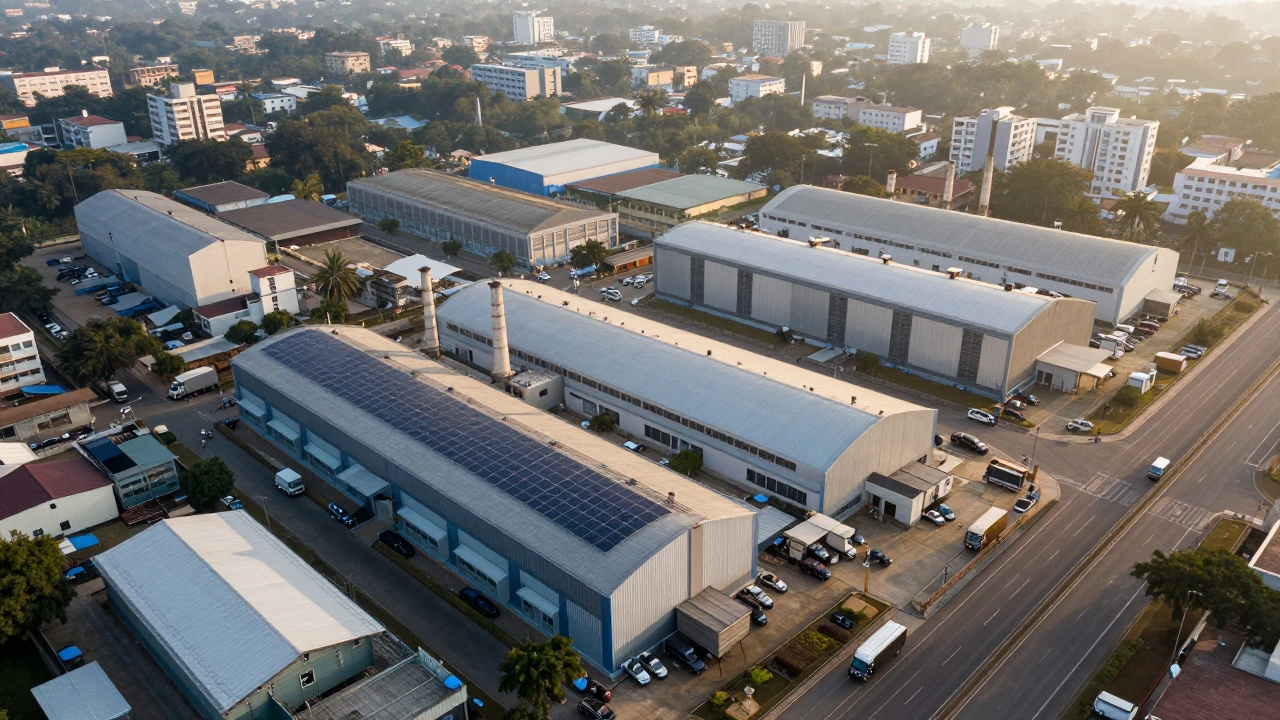
Bengaluru, once known only for software, now houses over 300 electronics manufacturing units. Companies like Dixon Technologies, Tata Electronics, and Lava have set up massive plants here. Nearby, Hosur and Sriperumbudur are packed with factories making circuit boards, batteries, and display modules. Chennai’s Sriperumbudur Industrial Corridor alone hosts more than 150 electronics firms, including Samsung’s largest mobile plant outside Korea.
Why Southern India? It’s Not Just Luck
Why not Delhi? Why not Mumbai? The answer lies in infrastructure, talent, and history.
- Skilled workforce: Southern states have the highest concentration of engineering graduates in India-especially in electronics and embedded systems. Institutions like IIT Madras and NIT Trichy churn out thousands of engineers every year.
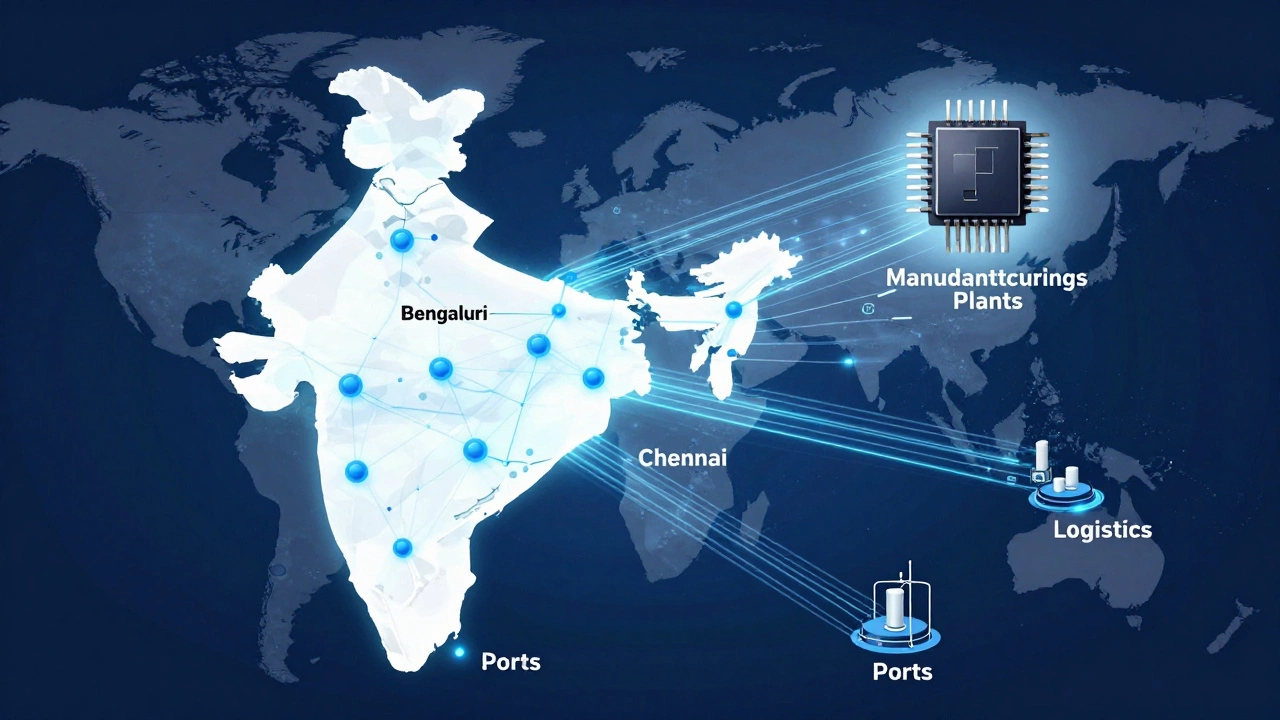
- Port access: Chennai Port and Ennore Port handle 40% of India’s electronics imports and exports. Raw materials like semiconductors, rare earth metals, and plastic resins arrive here by ship. Finished goods head out to Europe, Africa, and Southeast Asia.
- Government focus: Tamil Nadu and Karnataka offer 25% capital subsidy on machinery, 100% GST exemption for export units, and fast-track clearances. The state governments even built dedicated electronics parks with power backups and wastewater treatment plants.
- Supply chain density: In Bengaluru, you can walk from a PCB manufacturer to a connector supplier to a test lab-all within 10 kilometers. That kind of clustering cuts lead times and costs.
Compare that to northern states, where logistics are slower, skilled labor is scarcer, and power outages still happen. Southern India didn’t just get lucky-it built the ecosystem.
The Big Players and What They Make
It’s not just about volume. It’s about complexity.
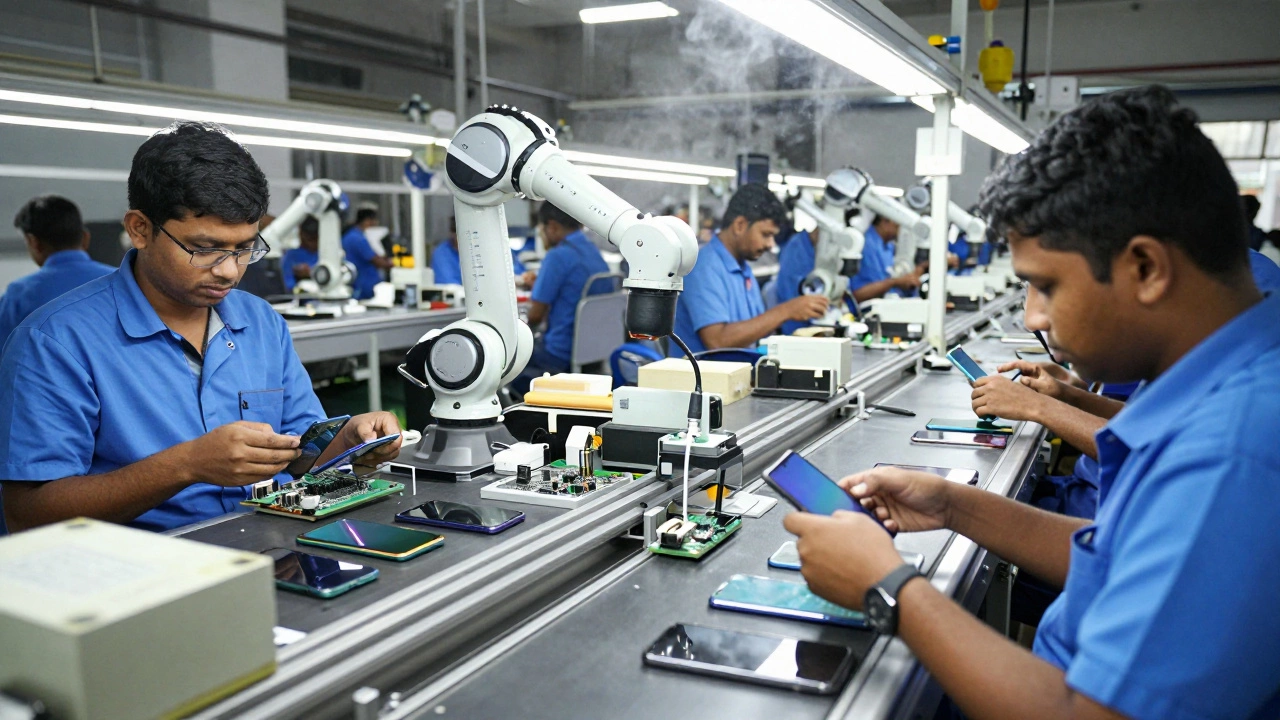
Apple’s suppliers-like Foxconn and Pegatron-now assemble over 50 million iPhones per year in India. Most of these come from the Sriperumbudur plant in Tamil Nadu. But they don’t just assemble. They now do final testing, software loading, and packaging locally. That’s a big shift from just screwing on backs.
Samsung’s Chennai factory produces 80 million phones a year. It also makes smartwatches, tablets, and TV modules. In 2024, it began producing 5G radio units locally for the first time-a sign that India is moving up the value chain.
Then there’s Dixon Technologies. Founded in 2002, it now makes everything from LED TVs to air conditioners to smart meters. In 2025, it became the first Indian company to export fully made-in-India smartphones to the UK and Australia. That’s not assembly-it’s ownership.
Even Chinese firms like BYD and Oppo are shifting more production to India. BYD now makes electric vehicle batteries in Tamil Nadu. Oppo’s new plant in Noida? It’s mostly for the domestic market. The export engines are still in the south.
What’s Missing? The Semiconductor Gap
Here’s the catch: India still doesn’t make its own chips.
Every smartphone, TV, or smart meter made in India still uses chips imported from Taiwan, South Korea, or the U.S. The cost? Over $12 billion a year. That’s why the Indian government approved a $10 billion semiconductor mission in 2022. Two plants are under construction: one in Gujarat (by Vedanta and Foxconn) and another in Assam (by Tata Electronics).
But those plants won’t be ready until 2027. Until then, India’s electronics manufacturing is like a car with a foreign engine. It runs well, but the core part isn’t homegrown.
Still, progress is real. India now produces 80% of the circuit boards used in its own devices. That’s up from 15% in 2020. Local firms like Medha Servo and Tejas Networks are designing their own microcontrollers. That’s the next frontier.
The Future: Beyond Phones
The real growth isn’t in smartphones anymore. It’s in what comes next.
- Medical electronics: Companies in Bengaluru are making portable ECG machines and ventilators for rural clinics.
- Industrial IoT: Tamil Nadu firms are building sensors for factories that monitor machine health in real time.
- Electric vehicle components: Batteries, chargers, and motor controllers are now being made in Andhra Pradesh and Karnataka.
- Defense electronics: DRDO and private firms like BEL are producing radar systems, communication gear, and drone controllers locally.
These aren’t just niche products. They’re high-value, high-margin items. And they’re being built in the same factories that made your last phone.
Who’s Winning? And Who’s Falling Behind?
Not every city is thriving. Mumbai has great finance and Bollywood-but not much electronics manufacturing. Delhi has offices, but not the supply chain. Pune is growing fast in automotive tech, but its electronics footprint is still small.
The real winners? Cities that invested early: Bengaluru, Chennai, Hosur, Tirupati, and Coimbatore. These places have trained workers, reliable power, and factories that operate 24/7. They’re not waiting for policy-they’re building it.
Meanwhile, states like Uttar Pradesh and Rajasthan are trying to attract investment with tax holidays. But without skilled labor or port access, they’re playing catch-up.
What This Means for You
If you’re a business owner looking to manufacture electronics in India, don’t look at the map-you look at the ecosystem.
Want to make smartphones? Go to Tamil Nadu. Need to design chips? Start in Bengaluru. Building solar inverters? Check out Gujarat. But if you want speed, scale, and supply chain depth? The south is still the only place that delivers.
And if you’re a student? Learn embedded systems, PCB design, or automation. Those skills are in demand here. Companies are hiring faster than colleges can graduate people.
India’s electronics story isn’t about cheap labor anymore. It’s about building something real-something that lasts. And the hub? It’s not a single city. It’s a corridor. A network. A movement.
And it’s growing every day.
Is Bengaluru the only electronics manufacturing hub in India?
No. While Bengaluru is a major center for design and R&D, the bulk of large-scale manufacturing happens in Tamil Nadu-especially in Sriperumbudur, Hosur, and Chennai. Other growing clusters include Noida, Hyderabad, and the Gujarat Semiconductor Park. But the southern corridor still handles over 70% of India’s electronics output.
Why doesn’t India make its own chips yet?
Chip manufacturing requires billions in investment, ultra-pure environments, and highly specialized talent. India lacked the infrastructure and experience until recently. Two semiconductor plants are under construction (in Gujarat and Assam) and expected to start production in 2027. Until then, India imports all chips, mostly from Taiwan and South Korea.
Which Indian companies are leading in electronics manufacturing?
Dixon Technologies is the largest contract manufacturer, producing phones, TVs, and smart devices for global brands. Tata Electronics is expanding rapidly with new plants for semiconductors and components. Lava, Micromax, and Realme India also design and assemble products locally. BEL and HAL lead in defense electronics.
Can small businesses set up electronics manufacturing in India?
Yes, but not easily. Large factories need $10 million+ in capital. However, small firms can start with contract assembly or component supply through government-backed electronics manufacturing clusters (EMCs). Many startups begin by making PCBs, cables, or enclosures for bigger players before scaling up.
How has the PLI scheme impacted electronics manufacturing in India?
The Production-Linked Incentive (PLI) scheme gave companies up to 6% cash incentive on incremental sales of electronics. Since its launch in 2020, India’s electronics exports jumped from $12 billion to over $30 billion in 2025. It attracted $20 billion in private investment and created over 500,000 jobs. It’s the main reason global brands moved production here.