Global Chemical Export Strategy Simulator
Select your business scenario to see which nation best fits your strategic needs.
Country Name
TaglineWhy this choice?
Reasoning text goes here.
| Country | Primary Strength | Key Products |
|---|
You might assume that because we see "Made in China" on everything from toys to tech gadgets, China automatically dominates every industrial sector with equal force. When it comes to chemicals, though, the picture is more nuanced than a simple label suggests. While China has indeed surged ahead to become the world's largest exporter of chemicals by volume and total value, Germany remains a powerhouse in high-value specialty chemicals. This isn't just about who ships more tons; it's about what those tons are made of and where they go.
Understanding this dynamic matters if you're in supply chain management, investing in industrial stocks, or trying to source raw materials for your own manufacturing business. The shift from traditional European dominance to Asian volume leadership has reshaped global pricing, logistics routes, and even geopolitical leverage. Let's break down exactly who holds the top spot, why the data looks the way it does, and what it means for the future of global chemical trade.
The Current Leader: China’s Volume Dominance
If you look at raw export data from major international bodies like the United Nations Comtrade database or the International Trade Centre, China stands as the undisputed leader in chemical exports. By 2025, China accounted for roughly 15-17% of global chemical exports, significantly outpacing its nearest competitors. This isn't a recent blip; it's the result of decades of strategic industrial planning.
Why did China take the lead? It boils down to three factors: scale, cost efficiency, and vertical integration. Chinese manufacturers have built massive integrated complexes, particularly in provinces like Shandong and Jiangsu, where upstream petrochemical feedstocks are converted into downstream products under one roof. This reduces transport costs and energy consumption per unit. Furthermore, the sheer size of the domestic market allows these companies to achieve economies of scale that smaller European or American firms simply cannot match.
However, volume doesn't always equal profit margin. A significant portion of China's chemical exports consists of basic commodities-think bulk polymers, fertilizers, and simple organic intermediates. These goods are essential but often command lower price points compared to specialized compounds. So, while China wins the race in quantity, the quality and specificity of the output tell a different story.
The Specialty King: Germany’s High-Value Niche
While China leads in volume, Germany consistently ranks second globally but first in terms of export value per ton. German chemical giants like BASF, Bayer, and Evonik don't compete on price alone; they compete on innovation, purity, and reliability. Their exports are heavily weighted toward specialty chemicals, pharmaceuticals, and advanced materials used in automotive and electronics sectors.
Consider the automotive industry. Modern electric vehicles require highly specific battery electrolytes, lightweight composites, and precision coatings. German manufacturers excel here because their R&D spending as a percentage of revenue is among the highest in the world. When a car maker in Detroit or Tokyo needs a compound that performs reliably at extreme temperatures, they often turn to German suppliers. This creates a sticky customer base that values performance over the lowest possible bid.
Germany's strength also lies in its regulatory environment. Strict environmental standards (like REACH in the EU) force German producers to maintain high safety and sustainability benchmarks. For buyers in regulated markets like North America and Western Europe, this compliance is a valuable asset, reducing liability risks. Thus, Germany maintains its position not by shipping more, but by shipping smarter.
Other Major Players Shaping the Market
Beyond the China-Germany duopoly, several other nations play critical roles in the global chemical ecosystem. Understanding them helps diversify your sourcing strategy or investment portfolio.
- The United States: Thanks to the shale gas boom, the U.S. has become a major exporter of ethylene-based plastics and liquefied natural gas (LNG)-derived chemicals. Its competitive advantage is cheap feedstock, making it a strong competitor in bulk commodity chemicals.
- South Korea: Home to giants like LG Chem and Lotte Chemical, South Korea focuses heavily on petrochemicals and electronic chemicals. They are key suppliers for the semiconductor and display industries, linking chemical trade directly to tech hardware demand.
- Japan: Japan excels in ultra-high-purity chemicals required for semiconductor manufacturing. Companies like Mitsubishi Chemical and Sumitomo Chemical provide niche materials that are irreplaceable in chip fabrication.
- Saudi Arabia: Leveraging vast oil reserves, Saudi Basic Industries Corporation (SABIC) dominates in basic petrochemicals and fertilizers. Their low-cost production makes them a formidable player in bulk markets.
Each of these countries fills a specific gap. If you need cheap plastic pellets, you might look to the U.S. or Saudi Arabia. If you need photoresists for chips, Japan is your go-to. If you need high-performance additives, Germany shines. And if you need volume at a competitive rate, China remains the default choice.
| Country | Primary Strength | Key Products | Market Position |
|---|---|---|---|
| China | Volume & Scale | Basic Polymers, Fertilizers, Intermediates | Largest by Total Value & Volume |
| Germany | Innovation & Quality | Specialty Chemicals, Pharma Ingredients | High Value-Added Exports |
| United States | Cheap Feedstock | Ethylene Plastics, LNG Derivatives | Rising Competitor in Bulk |
| South Korea | Tech Integration | Electronic Chemicals, Petrochemicals | Key Supplier for Electronics |
| Saudi Arabia | Low-Cost Energy | Petrochemicals, Ammonia | Dominant in Energy-Intensive Goods |
How Global Trends Are Shifting the Balance
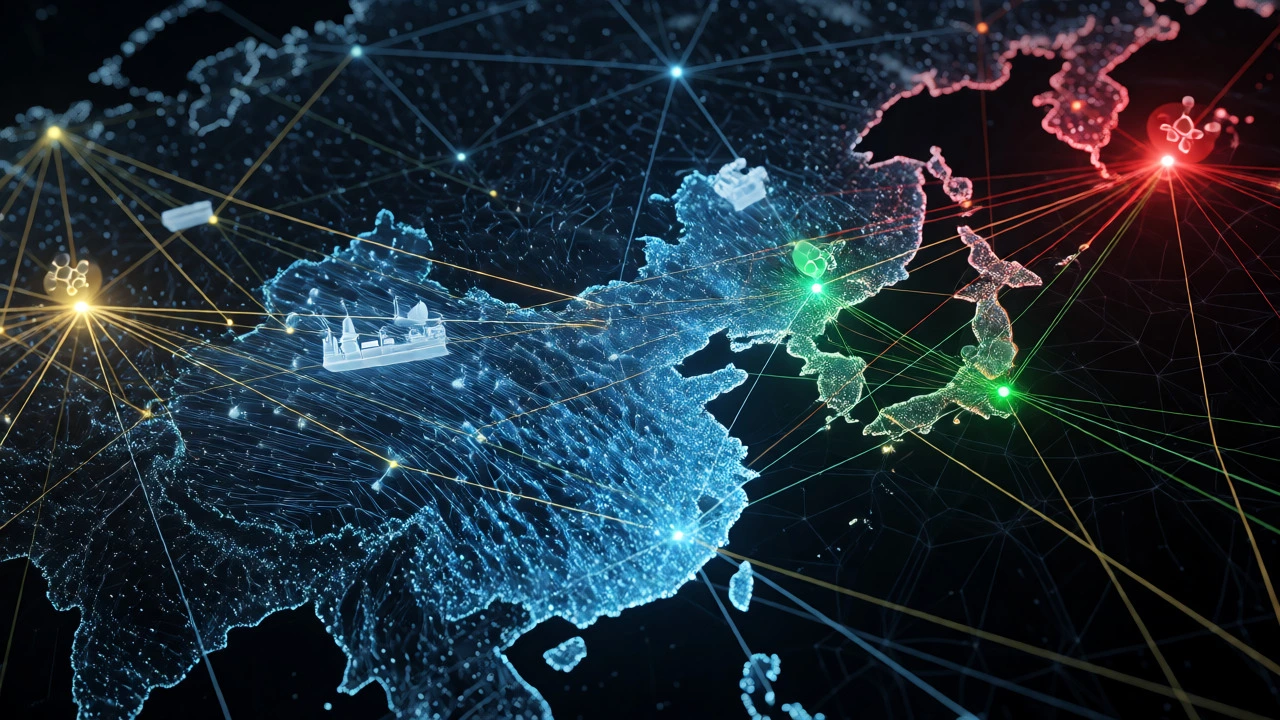
The title of "largest exporter" isn't static. Several macroeconomic forces are currently redrawing the map. One major trend is the push for supply chain resilience. After the disruptions of the early 2020s, many multinational corporations adopted a "China Plus One" strategy. This means keeping some production in China but adding another location, often in India or Vietnam, to mitigate risk. As a result, countries like India are seeing rapid growth in their chemical export capabilities, particularly in agrochemicals and generic pharmaceutical APIs.
Another factor is the green transition. Europe's carbon border adjustment mechanisms and stricter emissions targets are raising production costs for European manufacturers. Meanwhile, China is aggressively investing in green hydrogen and renewable energy for its chemical plants. If China can decouple its production from coal-fired power faster than anticipated, its cost advantage could widen further, solidifying its lead.
Finally, digitalization is changing how chemicals are traded. Platforms that allow real-time tracking of inventory and automated procurement are lowering barriers for smaller exporters. This democratization might fragment the market slightly, allowing niche players from Southeast Asia or Eastern Europe to capture more share in specific segments.
What This Means for Your Business
If you're sourcing chemicals, knowing who leads the pack helps you negotiate better. Don't just ask for quotes from the biggest name; ask about the composition of their product mix. If you buy from China, ensure you have rigorous quality control checks in place, as variability can be higher in mass-produced batches. If you buy from Germany, expect to pay a premium but save on downstream processing issues due to consistent quality.
For investors, watch the divergence between commodity and specialty chemical indices. Commodity prices fluctuate wildly with oil prices and global demand cycles. Specialty chemical companies, however, tend to have more stable margins because their products are harder to substitute. Tracking export data from customs authorities in China and Germany can give you early signals about economic health in these regions.
Ultimately, there is no single "best" exporter. There is only the best exporter for your specific need. China offers scale. Germany offers precision. The U.S. offers cost-effective feedstocks. Recognizing these distinctions prevents costly mistakes and opens up opportunities for strategic partnerships.
Is China still the largest exporter of chemicals?
Yes, as of late 2025 and early 2026, China remains the world's largest exporter of chemicals by both total value and volume. It accounts for approximately 15-17% of global chemical exports, driven by massive production capacity and cost efficiencies in basic and intermediate chemicals.
Which country exports the most expensive chemicals?
Germany typically leads in the average value per ton of exported chemicals. This is because German companies specialize in high-value-added specialty chemicals, pharmaceuticals, and advanced materials rather than bulk commodities, which lowers their overall volume but increases their revenue per unit.
Why is the US becoming a stronger chemical exporter?
The United States has gained competitiveness due to the shale gas revolution, which provides abundant and inexpensive ethane and natural gas liquids. These serve as low-cost feedstocks for producing plastics and other petrochemicals, allowing US manufacturers to undercut competitors on price in bulk markets.
What types of chemicals does China export most?
China primarily exports basic organic chemicals, inorganic chemicals, fertilizers, synthetic rubber, and various plastic resins. These are foundational materials used across industries, from agriculture to packaging and construction.
How do environmental regulations affect chemical exports?
Strict environmental regulations in Europe and North America increase production costs for local manufacturers but also drive demand for compliant, high-quality products. Conversely, looser regulations in some emerging markets may offer cost advantages but pose reputational and compliance risks for global buyers.