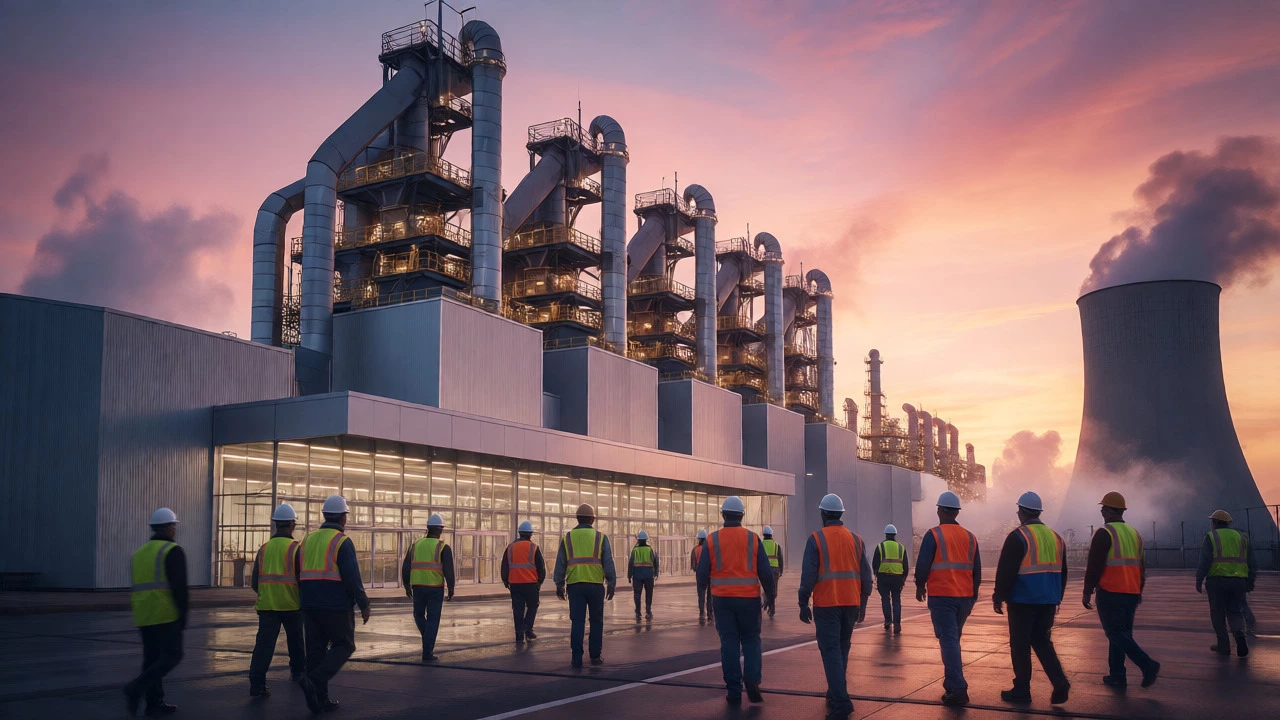
Nucor Ownership & Strategy Simulator
Explore who owns America's largest steelmaker and how their unique model compares to rivals like U.S. Steel and ArcelorMittal.
Major Institutional Shareholders
Click on a firm to see its influence type based on recent filings.
Selected Holder Details
Firm:
Type:
Influence Level:
Steel Giant Comparison
Select a competitor to see how their ownership structure differs from Nucor's decentralized, employee-aligned model.
Headquarters: USA
Control: Public/Dispersed
Key Feature: High Employee Ownership
Strategy: Agile, Non-Union, EAF Technology
The "Owner Mindset" Effect
Nucor pays lower base salaries but offers significant bonuses in stock. This aligns worker interests with company profitability. Adjust the sliders to see the theoretical impact on efficiency and loyalty.
Efficiency Score
Worker Loyalty
Cost Flexibility
Analysis will appear here.
You might assume that a giant like Nucor, which produces more steel than any other company in the United States, is controlled by a single wealthy family or a massive foreign conglomerate. That’s not how it works. If you’re asking who owns Nucor, the answer is surprisingly democratic: its shareholders do. But unlike many industrial giants where institutional investors hold all the cards, Nucor has a unique culture of employee ownership and decentralized management that sets it apart from rivals like U.S. Steel or ArcelorMittal.
Understanding the ownership structure of Nucor isn’t just about knowing who holds the stock certificates. It’s about understanding why this company operates differently, pays better, and consistently outperforms competitors in cyclical markets. Let’s break down exactly who holds the reins at Nucor, how its stock is distributed, and why its ownership model matters for the future of American manufacturing.
The Short Answer: Public Shareholders and Employee Stock
Nucor Corporation is a publicly traded company listed on the New York Stock Exchange under the ticker symbol NUE. This means there is no single "owner" in the traditional sense. Instead, ownership is fragmented across thousands of individual investors, mutual funds, pension funds, and-crucially-its own employees.
As of recent filings, the top holders of Nucor stock are major institutional investment firms. You’ll see names like Vanguard Group, BlackRock, and State Street Global Advisors near the top of the list. These firms manage money for millions of regular people through index funds and retirement accounts. So, if you have a 401(k) invested in an S&P 500 index fund, you technically own a tiny slice of Nucor.
But here’s where Nucor gets interesting. The company has a long-standing tradition of sharing profits with its workforce. Through various incentive plans, employees own a significant portion of the company’s outstanding shares. This isn’t just a perk; it’s a core part of their business strategy. When workers are owners, they tend to care more about efficiency, safety, and quality. It aligns everyone’s interests toward the same goal: making the company profitable and sustainable.
A Brief History of Independent Ownership
To understand why Nucor looks different today, you have to look back to 1969. Ken Iverson, along with Ransom E. Olds (yes, the car guy) and others, founded what was then called Nuclear Corporation of America. They weren’t trying to build a traditional steel mill. They were betting on a new technology called the Electric Arc Furnace (EAF).
Traditional steelmakers, often referred to as "integrated mills," relied on blast furnaces that required massive amounts of iron ore and coke. They were huge, inefficient, and union-heavy. Nucor’s approach was different. They used scrap metal as raw material, melted it down in smaller, flexible plants, and ran non-union operations. This allowed them to start small and grow fast.
Throughout the 1970s and 80s, while legacy steel companies struggled with debt and government bailouts, Nucor kept expanding. They didn’t rely on government protectionism or massive state subsidies. They grew by being leaner and smarter. This independent spirit shaped their ownership culture. They remained fiercely independent, avoiding mergers that would dilute their corporate identity until they were strong enough to buy others on their own terms.
Institutional Investors: The Big Players
While employees hold a meaningful stake, the bulk of Nucor’s equity is held by large asset managers. These institutions don’t run the day-to-day operations, but they exert influence through voting rights on board members and major strategic decisions.
| Investment Firm | Type of Holder | Influence Level |
|---|---|---|
| Vanguard Group Inc. | Passive Index Fund Manager | High Voting Power |
| BlackRock Inc. | Active & Passive Asset Manager | High Voting Power |
| State Street Corp. | Index Fund Provider | Moderate-High |
| Fidelity Management | Active Mutual Funds | Moderate |
| Capital Research Global | Long-term Active Investor | Moderate |
Notice that these are mostly passive index holders. They buy Nucor because it’s part of the S&P 500 or other benchmarks. They aren’t necessarily pushing for aggressive changes. This stability allows Nucor’s management team to focus on long-term growth rather than quarterly earnings pressure. In contrast, companies owned by private equity firms often face intense pressure to cut costs quickly and sell assets to boost short-term returns.

Employee Ownership: The Secret Sauce
If you walk into a Nucor plant, you won’t see the same hierarchy you’d find at a traditional steelworks. Managers and executives live in the same communities as the workers. They eat in the same cafeterias. And they share in the financial success of the plant.
Nucor’s compensation structure is heavily tied to performance. Base pay is relatively modest compared to industry averages, but bonuses can double or triple salaries when targets are met. A huge chunk of these bonuses is paid in stock, not cash. Over decades, this has accumulated into a substantial employee-owned block of shares.
This model creates a powerful feedback loop:
- Lower Costs: Employees work harder to reduce waste because they directly benefit from savings.
- Higher Quality: Workers take pride in output since their wealth is tied to the company’s reputation.
- Loyalty: Turnover rates at Nucor are historically lower than in the broader steel industry.
It’s worth noting that this isn’t a cooperative in the legal sense. Employees don’t vote one-per-person on major acquisitions. But the cultural impact of ownership is undeniable. It fosters a mindset where every worker acts like a shareholder.
How Nucor Compares to Other Steel Giants
Comparing ownership structures helps explain why some steel companies thrive while others flounder. Let’s look at three major players: Nucor, U.S. Steel, and ArcelorMittal.
U.S. Steel has changed hands several times. For years, it was dominated by Wall Street speculators and later faced takeover bids from Japanese firm Nippon Steel. Its ownership history is marked by volatility and external pressure. Recently, the potential acquisition by Nippon Steel sparked political debate in the US, highlighting how foreign ownership can complicate national security concerns.
ArcelorMittal is the world’s largest steel producer, headquartered in Luxembourg. It’s a global entity with complex cross-border ownership involving European and international investors. Their scale gives them pricing power, but their size makes them slow to adapt. They operate in dozens of countries, each with different labor laws and regulations.
Nucor sits in the middle. It’s American-headquartered, publicly traded, and focused primarily on North America. Its ownership is stable, domestic, and aligned with employee interests. This combination allows it to be agile without being chaotic.
Does Foreign Ownership Matter?
Given current geopolitical tensions, many readers wonder if foreign entities own significant stakes in Nucor. The short answer: yes, but indirectly. Global index funds include Nucor in portfolios sold worldwide. However, direct control remains firmly in US-based institutions and individuals.
Nucor has made strategic moves to secure its supply chain, including acquiring steel-making assets abroad, but its core operational control stays domestic. Unlike some tech companies where Chinese or Middle Eastern sovereign wealth funds hold large blocks, Nucor’s investor base is predominantly Western. This reduces regulatory risk related to foreign investment reviews, such as those conducted by the Committee on Foreign Investment in the United States (CFIUS).
For customers buying steel for construction or automotive projects, this domestic ownership provides a layer of supply chain security. You’re less likely to face sudden export bans or trade disputes disrupting your shipments compared to sourcing from overseas integrated mills.
The Future of Nucor’s Ownership
Will Nucor ever be bought out? It’s possible. The steel industry is consolidating. Smaller players are struggling with high energy costs and carbon regulations. Nucor, with its electric arc furnace technology, is better positioned for a greener future than blast-furnace competitors. This makes it an attractive target for larger global players looking to acquire low-carbon capacity.
However, Nucor’s management has historically resisted selling unless the price is right. They’ve shown willingness to make counter-offers to protect their independence. Any future change in ownership would likely involve a premium bid from another industrial giant or a consortium of private equity firms. Until then, the status quo holds: Nucor belongs to its shareholders, big and small, with employees holding a meaningful seat at the table.
If you’re an investor, this structure offers stability. If you’re an employee, it offers upside potential. If you’re a customer, it offers reliability. Understanding who owns Nucor reveals why it remains the benchmark for profitability in the modern steel industry.
Is Nucor a private or public company?
Nucor is a public company. Its shares are traded on the New York Stock Exchange under the ticker symbol NUE. This means anyone can buy and sell shares of the company, and ownership is distributed among thousands of individual and institutional investors.
Who is the largest shareholder of Nucor?
The largest shareholders are typically major institutional investment firms such as Vanguard Group and BlackRock. These firms hold shares on behalf of millions of individual investors through mutual funds and exchange-traded funds (ETFs). No single individual or family controls a majority of the company.
Do Nucor employees own stock?
Yes, employee ownership is a key part of Nucor's culture. Through bonus plans and stock purchase programs, a significant percentage of Nucor's outstanding shares are held by its employees. This aligns worker incentives with company performance, encouraging productivity and cost-efficiency.
Has Nucor been acquired by a foreign company?
No, Nucor has not been acquired by a foreign company. It remains an American-headquartered corporation. While foreign investors may hold shares through global funds, operational control and majority voting power remain with domestic institutional and individual shareholders.
Why does Nucor's ownership structure matter?
The ownership structure influences Nucor's strategy. With dispersed public ownership and strong employee involvement, the company focuses on long-term efficiency and organic growth rather than short-term gains or aggressive consolidation driven by private equity pressures. This has contributed to its consistent profitability.