US TV to India Compatibility Checker
Enter your TV's specifications below to determine if it can safely operate in India's power grid and receive local broadcasts.
You just bought a shiny new 4K OLED from Best Buy or Costco. It’s gorgeous, the picture is crisp, and you’re ready to ship it back home to Mumbai or Delhi. But here’s the catch: plug it into your Indian wall socket without thinking, and you might hear a loud pop followed by the smell of burnt electronics. Or worse, it powers on but shows nothing but static because the signal standard doesn’t match.
So, does a TV bought in the US work in India? The short answer is: it depends. Most modern TVs are technically compatible with Indian power grids, but there are critical hurdles involving voltage, broadcast standards, and smart software regions that can turn your dream purchase into a headache. Let’s break down exactly what you need to check before you pack that box.
The Power Supply Problem: Voltage and Frequency
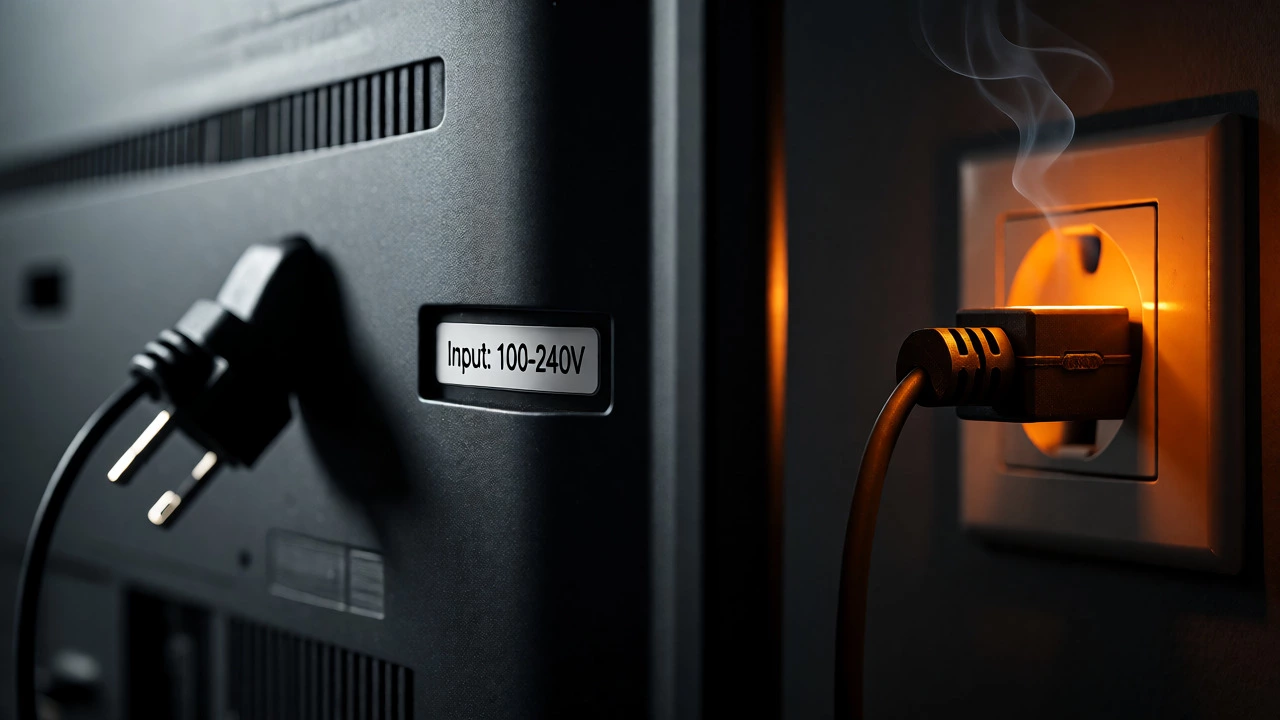
This is the most dangerous part of international electronics travel. In the United States, the standard household electricity runs at 120 Volts at 60 Hertz frequency. In India, the grid delivers 230 Volts at 50 Hertz frequency. If your TV only accepts 120V, plugging it directly into an Indian outlet will fry the internal power supply instantly.
Luckily, almost every flat-screen TV manufactured in the last 15 years (Samsung, LG, Sony, Vizio, etc.) comes with a "switch-mode" power supply. This means they are dual-voltage capable, usually labeled as "Input: 100-240V, 50/60Hz." You can verify this by looking at the sticker on the back of the TV. If it says 110V or 120V only, you absolutely need a step-down transformer. If it says 100-240V, you’re safe on the electrical front, though you’ll still need a physical plug adapter since US plugs (Type A/B) don’t fit Indian sockets (Type C/D/M).
| Label on TV Back | Action Required | Risk Level |
|---|---|---|
| 100-240V, 50/60Hz | Use a simple plug adapter only. | Low |
| 110V or 120V Only | Requires a heavy-duty Step-Down Transformer. | High (Direct plug = Damage) |
| Unknown / No Label | Assume 120V. Use a transformer to be safe. | Medium |
Broadcast Standards: NTSC vs. PAL/SECAM
Even if the TV turns on, will it show channels? This is where things get tricky. The US uses the NTSC analog video standard, while India historically used PAL and SECAM systems. However, India has largely moved to digital broadcasting via DVB-T2 (Digital Video Broadcasting - Second Generation Terrestrial).
Here is the good news: Modern digital tuners are often multi-standard. Many US TVs include ATSC (for US cable/antenna) and QAM (for cable). They rarely include the DVB-S2 tuner required for Indian satellite dishes or DVB-T2 for terrestrial antennas. If you plan to use the TV’s built-in tuner to watch local channels, your US TV likely won’t pick up anything. You will need an external set-top box provided by your Indian cable operator (like Tata Play, DishTV, or JioFiber) connected via HDMI. Since HDMI carries both video and audio digitally, the old NTSC/PAL conflict becomes irrelevant when using external sources like Roku, Apple TV, or Indian cable boxes.
Smart TV Software and App Regions
This is the hidden trap. When you buy a Samsung TV in the US, it comes pre-loaded with the US version of Tizen OS. It expects to connect to US servers for apps like Netflix, Hulu, and Disney+. When you move that same TV to India, the software region might not automatically switch. You might find that certain apps are missing, or the user interface displays prices in USD instead of INR.
Furthermore, streaming services have regional locks. Netflix content in the US differs from Netflix India. While you can change your account region, some hardware-level features tied to the specific model number sold in North America might behave oddly. For example, voice assistants like Bixby or Alexa might struggle with Indian accents or local language commands if the firmware wasn’t designed for the South Asian market. You can often factory reset the TV and sign in with an Indian email address to force a region update, but this isn’t guaranteed for all brands.
HDMI and Connectivity Nuances
Physical connections are generally universal thanks to HDMI, but pay attention to version numbers. A high-end US TV might support HDMI 2.1 for 4K@120Hz gaming. Ensure your Indian cable box or console supports the same specs if you want to utilize those features. Also, check the remote control. US remotes use IR (Infrared) which works fine, but some newer models use Bluetooth pairing that might require re-pairing after moving countries due to different regulatory frequency bands for wireless communication.
Warranty and Service Support
Let’s talk money. Electronics warranties are almost always regional. A warranty purchased in New York does not cover repairs in Bangalore. If your screen develops dead pixels or the mainboard fails, you are on your own. Finding spare parts for a US-specific model in India can be difficult and expensive. Local technicians might charge a premium because they have to import components. Compare this cost against buying a locally manufactured TV in India, which often comes with better after-sales service networks and easier access to spare parts.
Is It Worth Bringing One?
Why do people even try this? Usually, it’s about price differences or specific models unavailable in India. Sometimes, US Black Friday sales offer massive discounts on premium brands like Sony Bravia or LG OLEDs. However, factor in shipping costs, customs duties (which can be steep in India), potential voltage converters, and lack of warranty.
If you are bringing a small monitor (under 32 inches) for a workstation, it’s usually worth it because monitors are strictly digital and voltage-compatible. For large living room TVs, the hassle often outweighs the savings unless you are getting an incredible deal on a flagship model that is significantly cheaper than its Indian counterpart.
Checklist Before You Pack
- Check the Voltage Sticker: Must say 100-240V. If not, buy a transformer.
- Get a Plug Adapter: Bring a Type A/B to Type D/M adapter.
- Plan for External Tuner: Assume the built-in tuner won’t work for Indian channels.
- Factory Reset: Perform a full reset before shipping to clear US data.
- Customs Duty: Calculate if the duty makes the "deal" pointless.
Can I use a US power strip in India?
Yes, but only if the power strip itself is rated for 230V. Most cheap US power strips are rated for 120V only and will melt or trip their internal breaker if plugged into an Indian socket. Always check the label on the power strip before connecting your TV.
Will my US Roku stick work in India?
Generally, no. Roku devices are region-locked. A US Roku Stick will look for US channels and may not function correctly or update properly on Indian Wi-Fi networks. It is better to buy a local Android TV stick or Fire TV Stick Lite in India.
Do I need a voltage converter for an LED TV?
For modern LED/LCD/OLED TVs, you typically do not need a voltage converter because they accept 100-240V. You only need a physical plug adapter. However, older CRT TVs or very budget-friendly imported units might be single-voltage (120V), requiring a heavy transformer.
What happens if I plug a 120V TV into a 230V outlet?
The internal fuse will likely blow immediately, or the power supply board will burn out. You might see sparks or smell smoke. It is rarely recoverable without professional repair, which is often more expensive than buying a new TV locally.
Are HDMI cables compatible between US and India?
Yes, HDMI is a global standard. There is no difference between HDMI cables sold in the US and India. As long as the cable supports the bandwidth needed (e.g., HDMI 2.0 or 2.1), it will work perfectly regardless of where you bought it.