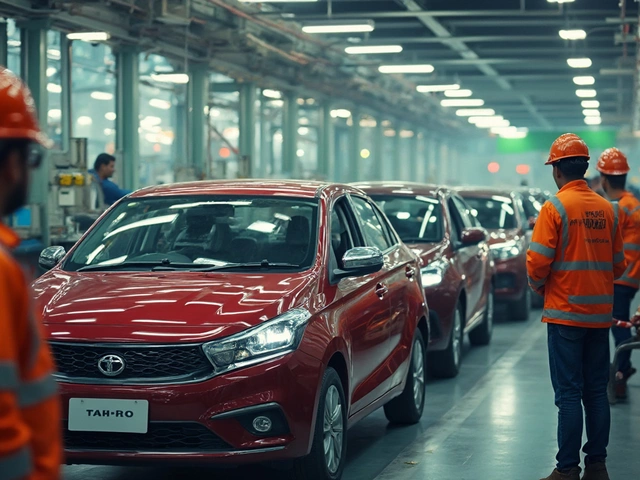
Local Content Percentage: What It Means for Indian Manufacturing
When we talk about local content percentage, the proportion of a product’s value that comes from materials, labor, and components made within India. It’s not just a government metric—it’s a measure of how much real manufacturing is happening here, not just assembly lines putting together imported parts. This number determines whether a factory qualifies for tax breaks, export incentives, or priority in public tenders. If your product has a 60% local content percentage, that means 60% of its cost comes from things made inside India—raw materials, circuit boards, screws, even the paint on the casing.
It’s not about waving flags. It’s about economics. Companies like Cipla, India’s leading pharma company and Reliance Industries, the biggest textile player in India have built entire supply chains around boosting local content. They don’t just import plastic pellets or chemical intermediates—they make them here. Why? Because the more you make locally, the less you pay in import duties, the more you control your costs, and the more you qualify for government support under schemes like PLI (Production Linked Incentive).
Look at electronics. India now makes smartphones, solar inverters, and medical devices locally, but not everything. A smartphone might have a screen from South Korea, chips from Taiwan, and batteries from China. But if the circuit board is made in Tamil Nadu, the casing in Uttar Pradesh, and the final assembly in Andhra Pradesh, that adds up. The local content percentage becomes your competitive edge. It’s why factories in Tamil Nadu export more electronics than any other state—they’ve mastered this balance.
Small manufacturers don’t need to build entire factories from scratch. They can start by sourcing local raw materials, partnering with nearby component makers, or even swapping parts with other small units. A plastic manufacturer in Ludhiana might buy pellets from Gujarat. A food processor in Maharashtra might use locally grown spices instead of importing them. Each swap increases local content percentage—and your profit margin.
This isn’t theoretical. The 5 M’s of manufacturing—Manpower, Machines, Materials, Methods, Measurement—put Materials, the physical inputs used in production right at the center. If your materials are imported, your costs are volatile. If they’re local, your supply chain is stable. And stability? That’s what banks and investors look for when they decide whether to fund your startup.
And here’s the thing: local content percentage isn’t just for big players. Even the smallest maker can track it. If you’re making a simple electronic device, count how much you’re buying from Indian suppliers. Even if it’s just 30% today, that’s a starting point. Next year, aim for 45%. Then 60%. That’s how you turn a small workshop into a government-approved manufacturing unit.
Below, you’ll find real stories from Indian manufacturers who’ve cracked this code—how they raised funding by proving local content, how they chose suppliers to boost their percentage, and how they turned this number into their biggest selling point. No theory. Just what worked.